How many pages is 1,000 words? (with conversion tables)
· Updated
By ToolsRacks Team · Writing Guides
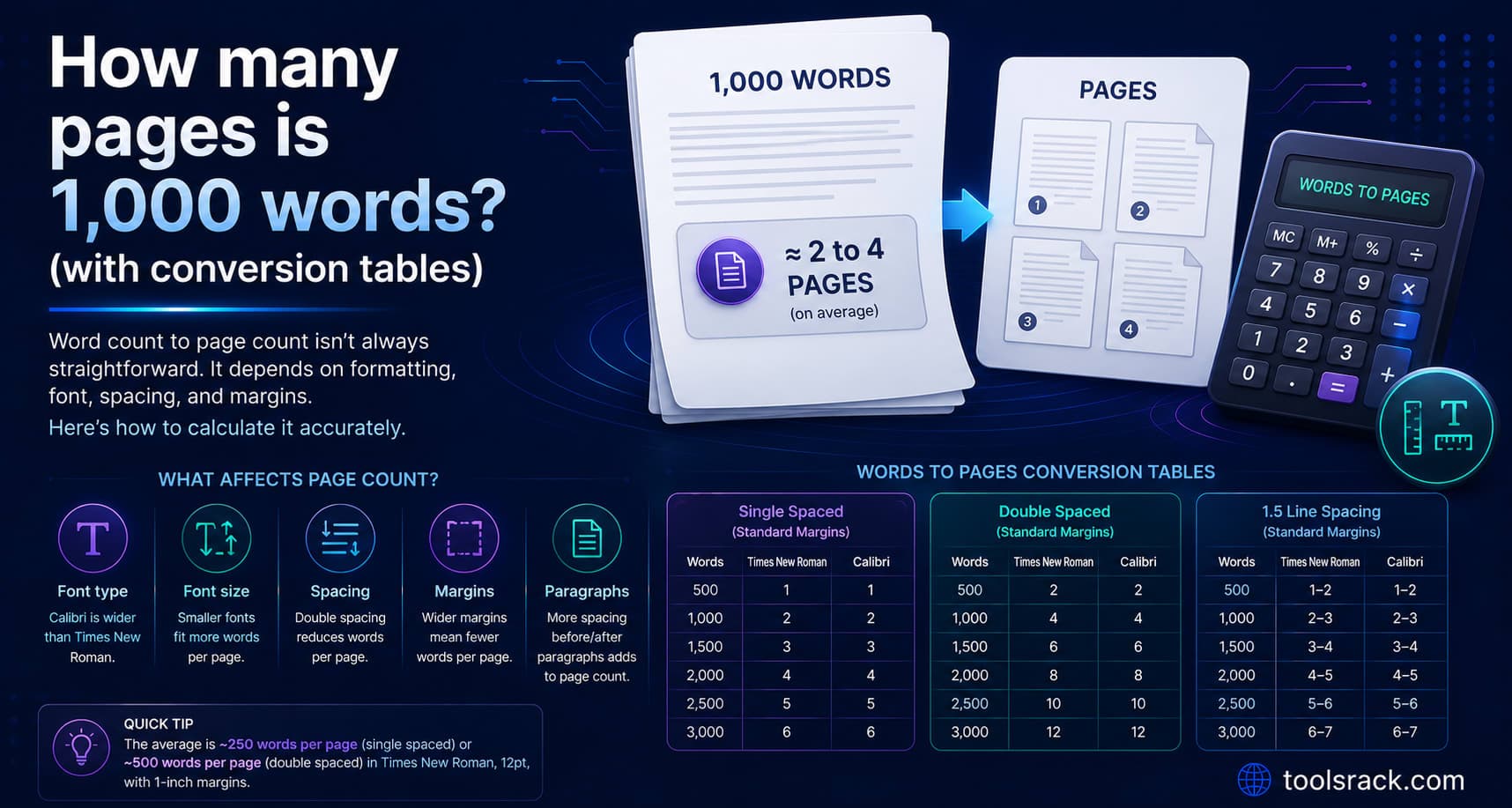
1,000 words is about 4 pages double-spaced or 2 single-spaced — but font, margins and spacing all move the number. Full conversion tables.
Your professor set a 1,000-word essay. Your client asked for "about three pages". Your scholarship application has a two-page limit. These are the same constraint expressed in two different units, and converting between them is not as simple as one number — it depends entirely on the formatting.
This page gives you the tables, the settings that change the answer, and how to check what you actually have.
- 1,000 words ≈ 4 pages double-spaced, or 2 pages single-spaced.
- The standard assumption: 12pt Times New Roman, 1-inch margins, A4 or US Letter — roughly 250 words per double-spaced page.
- Font matters more than people expect. Calibri 11pt fits noticeably more words per page than Times New Roman 12pt.
- Spoken aloud: 1,000 words is about 6–8 minutes at a normal speaking pace.
1,000 words is approximately 4 pages when double-spaced, or 2 pages when single-spaced, using 12pt Times New Roman with 1-inch margins. A double-spaced page holds roughly 250 words and a single-spaced page roughly 500. Changing the font, font size, margins or line spacing changes the page count, which is why word counts are the more reliable unit when a limit actually matters.
The conversion table
Based on the standard academic setup — 12pt Times New Roman, 1-inch margins, no headings or images breaking the flow.
| Word count | Single-spaced | 1.5 spacing | Double-spaced |
|---|---|---|---|
| 250 words | ½ page | ¾ page | 1 page |
| 500 words | 1 page | 1½ pages | 2 pages |
| 1,000 words | 2 pages | 3 pages | 4 pages |
| 1,500 words | 3 pages | 4½ pages | 6 pages |
| 2,000 words | 4 pages | 6 pages | 8 pages |
| 2,500 words | 5 pages | 7½ pages | 10 pages |
| 3,000 words | 6 pages | 9 pages | 12 pages |
| 5,000 words | 10 pages | 15 pages | 20 pages |
| 10,000 words | 20 pages | 30 pages | 40 pages |
Read it the other way round when you have been given a page limit instead: a 5-page double-spaced paper wants around 1,250 words, and a 10-page one wants around 2,500.
Why your document does not match the table
Every number above assumes one specific set of formatting choices. Change any of them and the page count moves — sometimes by a lot.
Font and size
This is the biggest single factor after line spacing. Fonts differ in width even at the same point size, so the same 1,000 words occupies different space.
| Font and size | Approx. words per double-spaced page | Effect |
|---|---|---|
| Times New Roman 12pt | ~250 | The academic baseline |
| Arial 12pt | ~215–230 | Wider letterforms — fewer words per page |
| Calibri 11pt | ~280–300 | Word's old default — noticeably more per page |
| Verdana 12pt | ~200–215 | Very wide — the fewest words per page of the common choices |
| Garamond 12pt | ~290–310 | Narrow — fits the most |
The practical consequence: a paper that lands at exactly 5 pages in Calibri 11 can run to 6 in Arial 12 without a single word changing. If a brief specifies a font, it is specifying the page count too.
Margins and page size
One-inch margins are the near-universal academic standard. Widening them to 1.25 inches removes roughly 10% of the text area. A4 (used in most of the world) is slightly taller and narrower than US Letter, so the same document can gain or lose a line per page when it crosses between them.
What breaks the estimate entirely
- Headings and subheadings — each one costs the space of two or three lines.
- Block quotes and bullet lists — more white space, fewer words per page.
- Images, tables and figures — a half-page figure removes 125 words of capacity from a double-spaced page.
- A title page and reference list — often excluded from a page limit. Check the brief.
- Dialogue — a new paragraph per speaker means many short lines, so fiction runs longer in pages than the word count suggests.
Handwritten pages
If the requirement is handwritten, the arithmetic changes completely, and it varies with your handwriting more than with anything else.
- Average handwriting on lined A4: roughly 100–150 words per page
- Small, dense handwriting: up to about 200 words
- Large handwriting or wide-ruled paper: as few as 75
So 1,000 words handwritten is typically 7–10 pages, not 4. Write one page in your normal hand, count it, and multiply — that is far more reliable than any average.
Speaking and reading time
Word counts convert to time as well as to pages, and this is what people usually need when preparing a talk.
| Word count | Spoken aloud (~130 wpm) | Read silently (~200 wpm) |
|---|---|---|
| 500 words | ~4 minutes | ~2½ minutes |
| 1,000 words | ~7–8 minutes | ~5 minutes |
| 2,000 words | ~15 minutes | ~10 minutes |
| 5,000 words | ~38 minutes | ~25 minutes |
A presentation pace is slower than a reading pace because of pauses, emphasis and slide changes. For a strict time limit, rehearse with a timer rather than trusting the arithmetic — nerves usually make people speak faster, not slower.
Common word-count requirements
| Type of writing | Typical length | Double-spaced pages |
|---|---|---|
| School essay | 500–1,000 words | 2–4 |
| University term paper | 1,500–3,000 words | 6–12 |
| Personal statement | 500–650 words | 2–2½ |
| Cover letter | 250–400 words | 1–1½ |
| Blog post | 1,000–2,000 words | n/a — published on the web |
| Dissertation chapter | 8,000–12,000 words | 32–48 |
How to check what you actually have
- Confirm the unit first. If the brief says words, count words. If it says pages, it is implicitly specifying formatting too — find out which.
- Ask what is excluded. Title page, abstract, references, appendices and footnotes are commonly outside the count, and assuming wrongly costs you either marks or a rewrite.
- Count the final text, not the working draft. Leftover notes and tracked changes inflate the number.
- Use a counter that shows both units. Our free word counter shows words, characters with and without spaces, sentences, paragraphs and reading time as you type, and runs entirely in your browser so nothing you paste is uploaded.
- Check the page count in the actual document with the exact font and spacing that will be submitted. The tables here are estimates; your file is the truth.
Questions people ask
How many pages is 1,000 words double-spaced?
About 4 pages in 12pt Times New Roman with 1-inch margins. In Calibri 11pt it is closer to 3½; in Arial 12pt it can reach 4½.
How many pages is 1,000 words single-spaced?
About 2 pages with the same settings. Single spacing roughly doubles the words that fit on a page.
Does a word counter count numbers and citations?
Yes. "12,500" counts as one word, and an in-text citation such as "(Smith, 2019)" counts as two. If your brief excludes references, remove them before counting.
How many words fit on a page in Google Docs?
Google Docs defaults to 11pt Arial with 1-inch margins, which holds roughly 500 words single-spaced and 250 double-spaced — close to the Times New Roman baseline, slightly fewer.
Why does Word show a different count from an online counter?
Different rules. Word can include or exclude footnotes and text boxes depending on your settings, and Google Docs excludes headers and footnotes by default. When a specific system will enforce the limit, trust that system's counter.
Is it better to go slightly over or slightly under a word limit?
Under, and only slightly. Many institutions allow ±10%, but some apply a hard cut-off or a penalty. Aim for 95–100% of the limit — an essay well under it usually reads as underdeveloped.
The one-number answer
1,000 words is 4 double-spaced pages or 2 single-spaced pages in the standard academic format. If a page count matters, check it in the real document with the required font — and if a word count matters, count the words rather than estimating from pages.