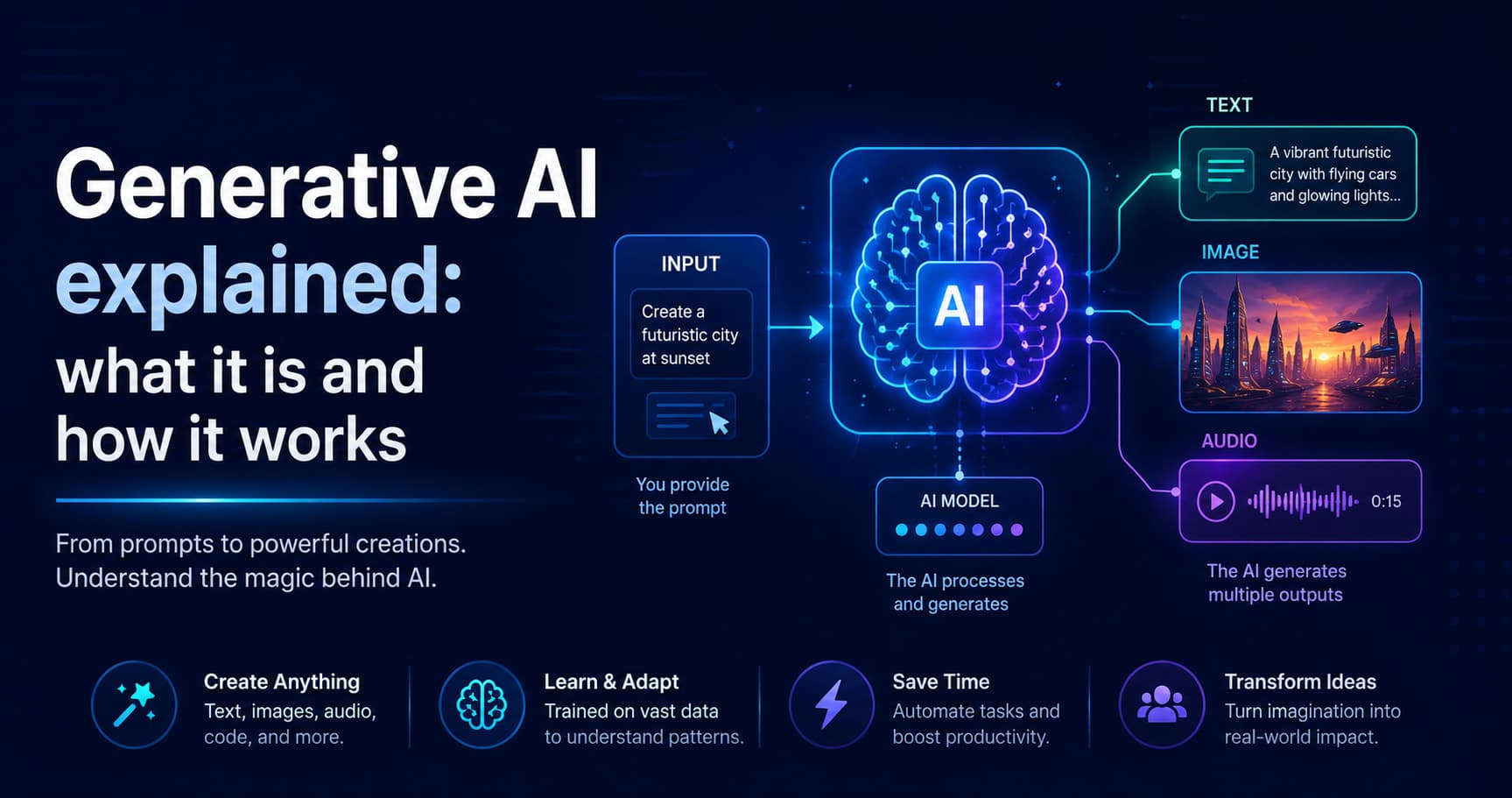
Generative AI explained: what it is and how it works
· Updated
By ToolsRacks Team · AI & Technology
How generative AI actually produces an answer, what each output type is reliable for, and why it states wrong facts so confidently.
You ask an AI tool for a product description and get something fluent, confident, and subtly wrong. You ask for a photo of a shop front and get six fingers on a hand. Both outputs come from the same underlying mechanism, and once you understand what that mechanism is actually doing, both results stop being surprising.
Generative AI is now embedded in ordinary work — drafting emails, writing first-pass code, producing marketing images, transcribing calls. Most guides describe what it can do. This one explains how it arrives at an answer, because that is what tells you when to trust it and when to check.
- What: Generative AI produces new text, images, code, or audio by predicting what comes next, one small piece at a time.
- How: Your prompt is split into tokens, the model assigns a probability to every possible next token, and one is chosen — repeatedly, until the output is complete.
- Why it invents things: The model optimises for plausible continuations, not for truth. Nothing in the process checks a fact.
- What to do about it: Treat output as a draft. Verify claims, check originality before publishing, and keep a human decision at the end.
What generative AI actually is
Generative AI is software that produces new content by repeatedly predicting the most likely next piece of a sequence. That is the whole idea. A text model predicts the next token; an image model predicts how to remove noise from a random field one step at a time. Neither retrieves an answer from a database, and neither reasons about truth in the way a person would.
The word "generative" distinguishes it from the AI that came before it. A spam filter classifies — it puts a message into a bucket. A recommendation engine ranks. A generative model creates something that did not exist in its training data, assembled from patterns it did.
This distinction matters practically. A classifier can be wrong in a measurable way: you can count how often it mislabels a message. A generative model can be wrong in an unbounded number of ways, and it produces every one of them with the same confident tone.
The four output types, and what each is genuinely good at
People talk about "AI" as one thing. In practice you are choosing between four very different capabilities, each with a different reliability profile.
| Output | Reliable for | Unreliable for |
|---|---|---|
| Text | Restructuring, summarising, tone changes, first drafts, explaining code you paste in | Statistics, dates, citations, quotes, anything specific it was not given |
| Images | Concept art, mood boards, backgrounds, placeholder visuals | Text inside the image, precise counts of objects, consistent characters across images, real logos or people |
| Code | Boilerplate, tests, regular expressions, translating between languages, explaining unfamiliar code | Anything security-sensitive, current library APIs, code you will not read before shipping |
| Audio | Transcription, rough voiceover for drafts, translation of speech | Names, technical jargon, overlapping speakers, anything requiring a legally accurate record |
The pattern across all four rows is the same: models are strong at transformation — taking something you supply and reshaping it — and weak at recall of specific facts. If the information has to come out of the model rather than out of your prompt, verify it.
What happens between your prompt and the answer
Here is the actual sequence for a text model, with no metaphors.
- Tokenisation. Your prompt is split into tokens — roughly word fragments. "Generative" might be one token; an unusual product name might be four. This is why models are quietly bad at counting letters in a word: they never see the letters as separate units.
- Probability over the vocabulary. The model computes a probability for every token in its vocabulary as the next one. Not a choice — a full distribution, tens of thousands of numbers wide.
- Sampling. One token is picked from that distribution. The temperature setting controls how much randomness is allowed. Low temperature picks the most likely token nearly every time, which reads as consistent but bland. High temperature reads as creative and drifts off-task more often.
- Repeat. The chosen token is appended to the input and the whole process runs again for the next token, and the next, until the response ends.
Two consequences follow directly from step 3. First, the same prompt can produce different answers on different runs — that is sampling working as designed, not a bug. Second, once an early token sends the answer down a wrong path, every subsequent token is predicted given that mistake, which is why a wrong answer often stays confidently wrong all the way to the end rather than self-correcting.
Why models state wrong facts so confidently
A generative model has no representation of truth — it has a representation of what text usually looks like. "Hallucination" is a polite name for the model doing exactly what it was built to do: produce a fluent continuation.
The confident tone is the part that catches people out, and it has a simple cause. Confident phrasing is common in the training data for factual statements, so confident phrasing is what gets predicted around a factual claim — whether or not the claim is right. There is no internal signal that separates "I have seen this many times" from "this merely sounds like the sort of thing that gets said."
Specific categories to distrust by default:
- Citations and quotes. Plausibly formatted references to papers, cases and articles that do not exist are one of the most common failure modes. Always open the source.
- Numbers. Percentages, prices, dates and version numbers are generated the same way as prose. A statistic with no source next to it is not a statistic.
- Anything after the training cutoff. Models are trained on data up to a fixed date. Ask about something newer and you may get a confident answer built out of older patterns rather than an admission of ignorance.
- Details about small or niche entities. The less the model has seen about a company, tool or person, the more the output is reconstruction rather than recall.
Publishing AI-assisted work without getting burned
Most of the real risk in generative AI is not technical, it is editorial. Four checks handle the majority of it.
Check originality before you publish. Models are trained on public text, and output can land close to a source passage — particularly for definitions, standard explanations and well-worn topics. Running a draft through our free plagiarism checker samples sentences and searches for matching public pages, so you can see which passages already exist somewhere before your name goes on them.
Verify every specific claim. Not the argument, the specifics: numbers, names, dates, quotes, links. If you cannot open a source for a claim, cut the claim.
Edit for a real point of view. Unedited AI output has a recognisable shape — balanced, hedged, structurally symmetrical, saying little that could be disagreed with. Search engines and readers both discount it. The fastest fix is to add something only you know: a number from your own data, a mistake you made, a case where the general advice does not apply.
Know your obligations. Disclosure requirements differ by platform and jurisdiction, and rules around training data and image rights are still moving. If you are publishing commercially, check the current terms of the specific tool you used rather than relying on a general summary.
Questions people ask about generative AI
Is generative AI the same thing as ChatGPT?
No. ChatGPT is one product built on one family of models. Generative AI is the broader category, which includes image, audio, video and code models from many providers. Confusing the two leads people to assume every model behaves like the one chat interface they have used.
Why does it give me a different answer each time?
Because the next token is sampled from a probability distribution rather than picked deterministically. Lowering the temperature setting, where the tool exposes it, makes answers more repeatable at the cost of variety.
Can it replace writers and designers?
It replaces the blank page, not the judgement. The model does not know your audience, your constraints, or which of three plausible directions is the right one. In practice the work shifts from producing a first draft to specifying and editing one — a real change in the job, not the end of it.
Why is it so bad at text inside generated images?
Image models learn visual patterns, not spelling. Letterforms are treated as shapes that tend to appear in certain arrangements, so output looks like text at a glance and falls apart on reading. Add real text in a design tool afterwards rather than fighting the prompt.
Is AI-generated content safe to publish for SEO?
Search guidance focuses on whether content is helpful and original, not on how it was produced. Unedited output tends to fail that bar because it is generic by construction. Content that is checked, corrected and given a genuine point of view generally does not.
Do I need technical skills to use these tools?
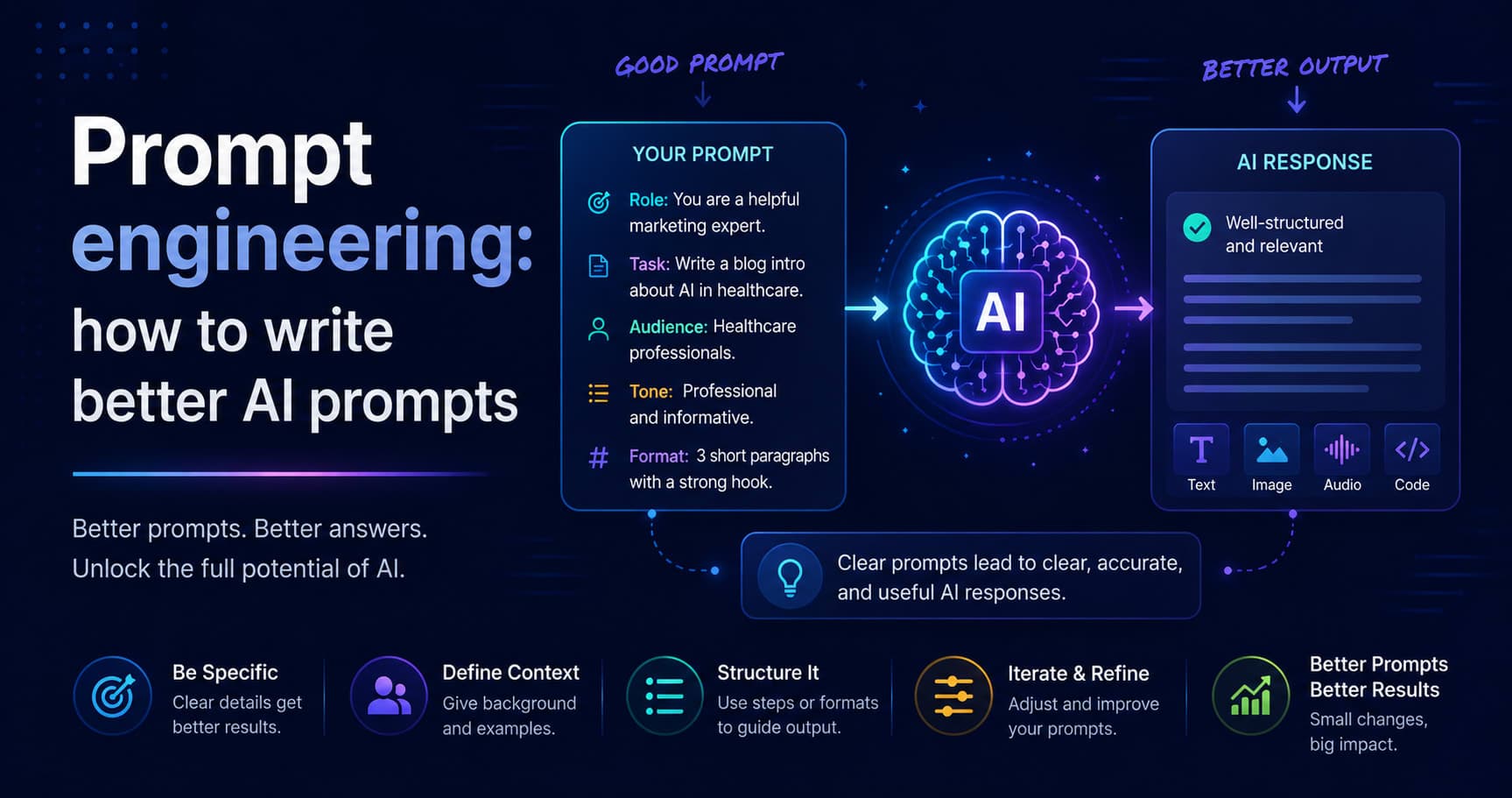
Not to use them. To use them well, the useful skill is specification — describing the task, the audience, the format and the constraints precisely. That is a writing skill rather than a programming one, and it is what prompt engineering is really about.
The short version
Generative AI predicts plausible continuations. It is excellent at reshaping material you give it and unreliable at recalling specifics you did not. Use it for structure, drafts and transformation; verify anything factual; and keep a human decision between the output and the publish button.